



























YTU Climbed 25 Places in the QS Sustainability Rankings
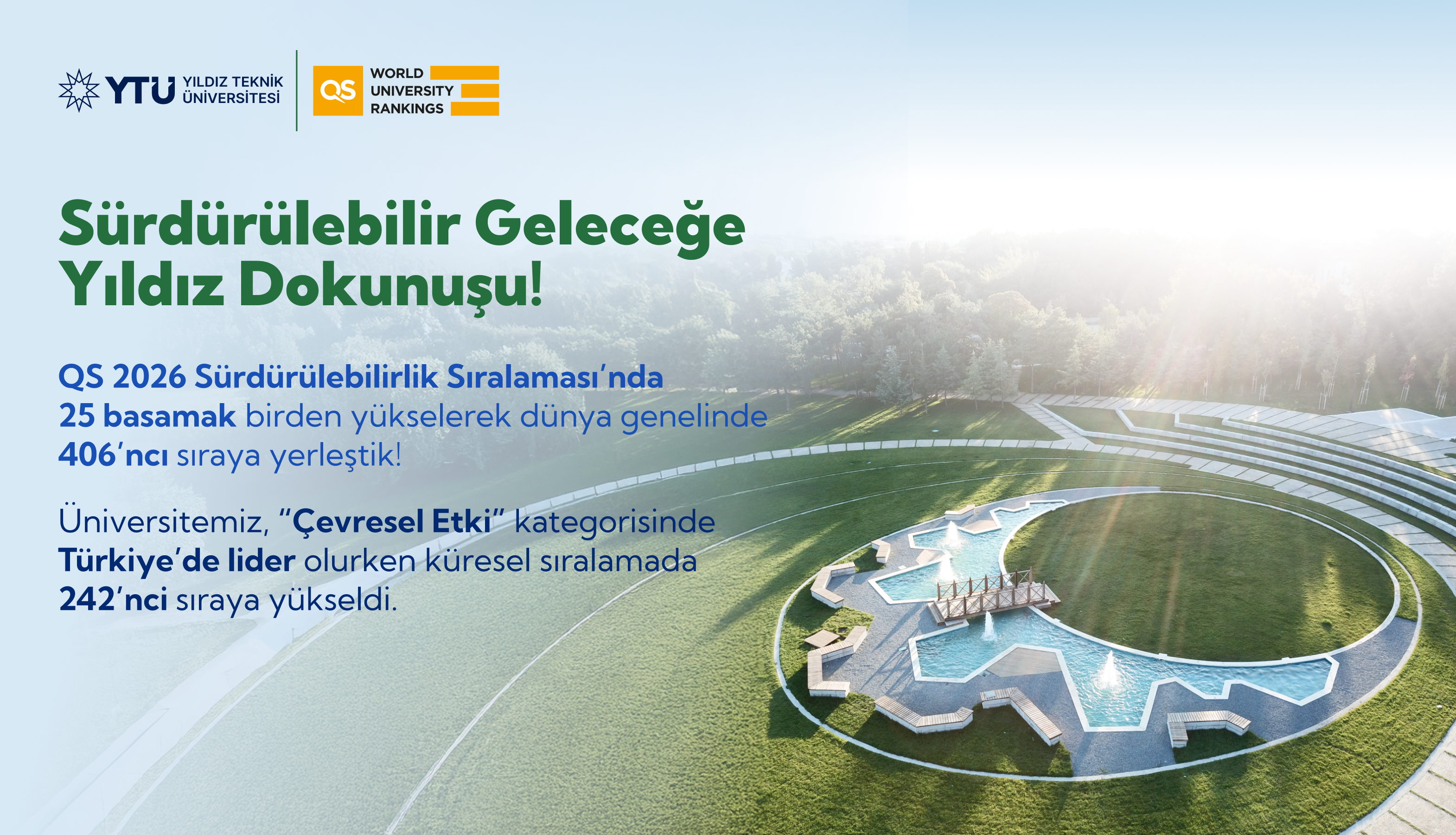
Yıldız Technical University climbed 25 spots in the Quacquarelli Symonds (QS) 2026 Sustainability Rankings to rank 406th globally. With this result, YTÜ solidified its position as the 5th-ranked university in Turkey.
Quacquarelli Symonds (QS), one of the world’s most prestigious university ranking organizations, has announced the results of the 2026 Sustainability Rankings (QS World University Rankings: Sustainability 2026). Yıldız Technical University (YTÜ), which was ranked 431st last year, made a significant leap of 25 places this year, rising to 406th place among 2,002 universities globally. With this result, YTÜ achieved the 84th rank among 827 universities in Asia and the 5th rank among the 53 universities in Turkey included in the ranking.
In the evaluation conducted across three main categories, YTÜ’s most striking performance was in the Environmental Impact category, where it ranked 1st in Turkey. Globally, YTÜ ranked 242nd in this category.
Vision for a Green and Responsible University
YTÜ Rector Prof. Dr. Eyüp Debik, commenting on the matter, emphasized that this success was no accident, stating, “As Yıldız Technical University, we embrace sustainability as a way of life. This significant 25-rank rise in the QS 2026 Sustainability Rankings and our placement at 406th globally are a key outcome of our determination and systematic efforts in this area. In particular, our position at the top as Turkey’s best university in the Environmental Impact category fills us with pride. This achievement reflects the most up-to-date manifestation of our “green and responsible university” vision, which we have embraced across every aspect of our institution—from our research infrastructure and curriculum to campus life and social projects. This accomplishment belongs to the entire Yıldız Family. Rankings serve as a tool to demonstrate the extent to which we fulfill our responsibilities toward society and the planet. "Our goal is to continuously improve our performance not only in the 'Environmental Impact' category but also in the 'Social Impact' and 'Governance' areas, thereby establishing our name as a global brand in the field of sustainability," he stated.
Turkey’s “Environmental Impact” Leader: YTÜ
YTÜ’s strongest performance in the report was in the Environmental Impact category, where it ranked first in Turkey. The university, which ranks 242nd globally, drew attention with a score of 74.5 in this category. Underpinning this success, in the "Environmental Education" subcategory, YTÜ ranked 166th globally and 2nd in Turkey, demonstrating its commitment to sustainability education. In the "Environmental Sustainability" category, it ranked 276th globally and 3rd in Turkey.
Detailed Performance by Category
YTÜ also demonstrated consistent performance in the report’s other main categories. In the “Governance” category, it scored 83.5 points, ranking 463rd globally and 8th in Turkey. In the “Social Impact” category, it ranked 718th globally and 11th in Turkey. The "Knowledge Exchange" subcategory, which falls under this category, was the subcategory where YTÜ achieved its highest score with 88.7 and ranked 269th globally.
Strong Position in Asian and Global Rankings
The announced results demonstrated that YTÜ has strengthened its competitive position not only in Turkey but also on a continental and global scale. Ranking 406th in the global ranking of 2,002 institutions and 84th in the list of 827 Asian universities confirmed the university’s visibility on the international stage and its commitment to sustainability.
About the QS Sustainability Rankings
Published by QS, the QS World University Rankings: Sustainability is a ranking that measures the performance of universities worldwide in environmental, social, and governance (ESG) areas. This ranking evaluates universities based on criteria such as sustainable education, research, institutional strategy, social equity, the impact of alumni, and campus management. By focusing on an institution’s “impact-driven” aspects, it offers students, academics, and policymakers the opportunity to compare not only an institution’s academic strength but also its sustainability commitments.
Other News