

























YTÜ Offers Graduate Education Opportunities to Employees of R&D Companies
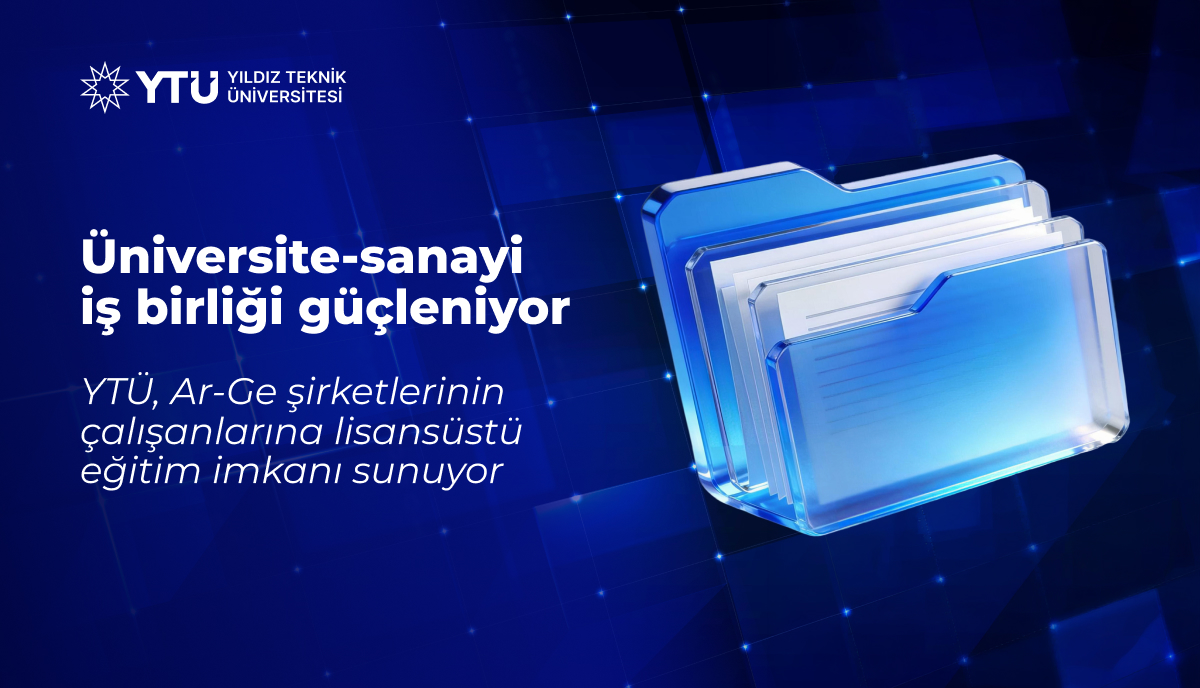
Under YTÜ’s new university-industry collaboration model, R&D companies will be able to enroll up to three of their employees in master’s or doctoral programs each academic year. R&D projects conducted at companies can be transformed into graduate theses and grant-funded projects under the guidance of YTU faculty members.
Yıldız Technical University (YTÜ) is implementing a new university-industry collaboration model that integrates companies’ R&D activities with graduate education processes. Under the “University-Industry Collaboration Protocol,” prepared by the YTÜ Institute of Natural Sciences and approved by the YTÜ Senate, will allow company employees to transform the R&D projects they are working on into master’s or doctoral theses.
Thanks to this model, technical and scientific problems encountered in companies will be researched under the guidance of YTÜ faculty members, and the university’s knowledge base will be transferred to the companies’ product and technology development processes.
Each company may apply with up to three employees per year
Each R&D company that signs the protocol may apply for up to three employees per academic year across both master’s and doctoral programs. Unused quotas for a given year cannot be carried over to the following year.
The company will apply to the YTÜ Institute of Natural Sciences by specifying the R&D problem and the personnel who will work on it. The suitability of the R&D topic for a thesis will be evaluated by the relevant department committee and the Institute’s Board of Directors.
Each candidate must meet YTÜ’s current graduate application and admission requirements. Nomination under this protocol does not constitute an automatic right to admission.
R&D projects will be transformed into graduate theses
A thesis advisor will be assigned to the student accepted into the program during the first semester. The student’s coursework and the R&D project provided by the company will be conducted concurrently under the guidance of the thesis advisor.
If deemed necessary, a second thesis advisor may be assigned at the joint request of the R&D company, the student, and the thesis advisor. In this way, the technical requirements of the company’s project and the academic standards of the graduate study will be integrated into a common research plan.
Theses will be linked to grant-funded projects
In order for the student to proceed to the thesis phase, the R&D project must be developed under the supervision of the thesis advisor, and an application must be submitted to the TÜBİTAK 1505 University-Industry Cooperation Support Program or a similar grant program.
This arrangement aims to enable companies to prepare project proposals with strong academic merit, to align graduate theses with national and international R&D funding, and to transform research results into marketable products.
Intellectual property and trade secrets will be protected
Intellectual and industrial property rights—such as inventions, utility models, designs, and software—that may arise from project and thesis work will be governed by a separate agreement prepared in accordance with the parties’ respective contribution ratios.
Academic publications will be prepared in a manner that protects companies’ trade secrets. The company may review the draft publication submitted to it for confidentiality and request revisions.
University-industry collaboration will be strengthened
Under the protocol, which will remain in effect for three years, company employees will be able to continue their academic development in parallel with the R&D projects they are assigned to. Companies will also be able to address their technical challenges by leveraging YTÜ’s academic consulting and research capabilities.
The new model aims to contribute to the training of qualified R&D personnel, the enhancement of companies’ project development capabilities, and the transformation of academic research into products and technologies.
The protocol was prepared in accordance with the provisions of the Higher Education Law No. 2547, the Law on the Support of Research, Development, and Design Activities No. 5746, the Technology Development Zones Law No. 4691, and the relevant regulations and legislation.
Other News