YTÜ’s SMARTNET Project Received an Award Under the Competitive Sectors Program

The SMARTNET Project—in which Yıldız Technical University is the ultimate beneficiary and which is carried out in partnership with three universities—was honored at the IPA II Competitive Sectors Program held in Ankara. With a budget of 2,498,000 euros, the project aimed to support the commercialization of scientific knowledge and innovative ideas developed at universities.
The “Smart Network for Technology Transfer and Commercialization Using the Funnel Model (SMARTNET)” project, for which Yıldız Technical University is the beneficiary and which was implemented in partnership with Hasan Kalyoncu University, Istanbul Technical University, and Gebze Technical University, was honored at the Closing Conference of the IPA II Phase of the Competitive Sectors Program, which was co-funded by the Ministry of Industry and Technology and the European Union.
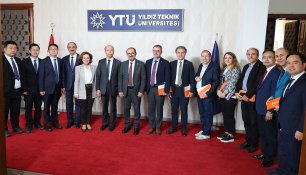
At the event held in Ankara under the theme “Turning Innovation into Impact,” Minister of Industry and Technology Mehmet Fatih Kacır presented plaques to projects successfully completed under the program. On behalf of YTÜ, our Vice Rector Prof. Dr. Ahmet Göksel Ağargün accepted the plaque.

“Turkey has become one of the most important players in European value chains”
Minister of Industry and Technology Mehmet Fatih Kacır highlighted the importance of economic and trade relations between Turkey and the European Union, noting that the bilateral trade volume has approached $235 billion. Stressing that Turkey has attained an increasingly strong position within Europe’s supply networks, Kacır said, “As Turkey, we are making significant contributions to the development and competitiveness of the European economy.”
Noting that 260 million euros in funding has been allocated to 43 projects in 23 cities under the Competitive Sectors Program, Kacır explained that these investments aim to enhance the competitiveness of Turkish industry and strengthen the integration between Turkish industry and European value chains. Noting that research, technology, and innovation infrastructures have been developed under the program, Kacır stated that steps to strengthen Turkey-EU cooperation and consolidate Turkey’s role in Europe will continue in the coming period.

Achievements of the Competitive Sectors Program Were Shared
The Closing Conference of the IPA II Phase of the Competitive Sectors Program—carried out with joint funding from the Ministry of Industry and Technology and the European Union—brought together public institutions and international stakeholders. Held under the theme “Turning Innovation into Impact,” the conference addressed the projects implemented and the achievements made during the program.
In the evaluations presented at the conference, the strengthening of research and development capacity, the enhancement of industrial competitiveness, and the support for digital and green transformation emerged as key topics. During the event, where plaques were presented to successfully completed projects, SMARTNET was among the projects honored.
SMARTNET Aimed to Commercialize Scientific Knowledge
The SMARTNET Project, which began on May 25, 2022, and was completed on May 24, 2025, was carried out with the aim of supporting the transformation of knowledge generated at universities and research centers into economic value. Under the project, which involved Operations Coordination Unit Director Prof. Dr. Zeynep Işık and unit member Lecturer Mehmet Mete Yılmaz, a model was developed to guide technology startups through the stages of evaluation, development, mentoring, and commercialization; and to prepare ideas with high commercialization potential for investment and market access.
SMARTNET supported technology transfer and commercialization
Yıldız Technical University was the ultimate beneficiary of the project, which was carried out with a total budget of 2,498,000 euros. Hasan Kalyoncu University, Istanbul Technical University, and Gebze Technical University were among the project partners.
SMARTNET aimed to create a network that strengthens collaboration among universities, technology transfer offices, technology parks, entrepreneurs, mentors, and investors. Based on the funnel model—the foundation of the project—the goal was to identify startups with high commercialization potential by screening numerous academic studies and innovative ideas through stages such as technical validation, market analysis, and prototyping.
Four national acceleration programs were organized
As part of the project’s national component, four separate acceleration programs were conducted, open to technology parks, technology transfer offices, SMEs, and academic entrepreneurs across Turkey. Startups accepted into the programs received training on business model validation, commercialization strategies, intellectual and industrial property rights, financial projections, and scalability.
Entrepreneurs also participated in one-on-one mentoring sessions with experts in their respective technology fields. At the “demo day” events held at the end of each program, the startups presented their projects to investment funds, angel investor networks, and industry representatives. Based on the jury’s evaluations, the startups deemed eligible to participate in international programs were identified.
Startups Were Prepared for European Markets
Two international accelerator programs were organized in Spain and Germany for technology startups that stood out in the national programs. The programs, held in Madrid, Barcelona, and Berlin, aimed to help the startups establish connections with European technology ecosystems and develop opportunities to expand into international markets.
As part of the programs, entrepreneurs received support on entering the European market, complying with local regulations, protecting intellectual property, and developing international business. The startups also met with European investors, venture capital funds, and potential industry partners to evaluate investment and collaboration opportunities.
Other News