YTÜ showcased its scientific expertise and green technology projects to the world at COP31

Yıldız Technical University, in collaboration with YTÜ Yıldız Technopark, participated in the United Nations Climate Change Conference (COP31) held in Antalya with 30 projects. The conference, which also featured 12 companies based at the technology park, included panels on clean energy, water and ocean literacy, the circular economy, green industry, and sustainability; and the university’s research, student projects, and domestic certification system were shared with international participants.
Yıldız Technical University brought its academic work, technology projects, and entrepreneurial experience in the fields of combating climate change and green transformation to the international stage at COP31. At the conference held in Antalya, panels organized in the Green Zone and Blue Zone addressed a wide range of topics, from the widespread adoption of clean hydrogen to water security, and from the circular economy to green industrialization. Our university’s faculty members, students, and companies based at YTÜ Yıldız Technopark showcased the solutions they have developed at exhibition booths while also meeting with international stakeholders.

Participated in COP31 with 30 projects
YTÜ and YTÜ Yıldız Technopark participated in COP31 with a total of 30 projects. Twelve companies within YTÜ Yıldız Technopark also showcased the technologies they developed and their sustainability-focused initiatives as part of the conference.
The university’s conference programs were attended by Rector and YTÜ Yıldız Technopark Board of Directors Chair Prof. Dr. Eyüp Debik, Vice Rector Prof. Dr. Güleda Engin, Chief Advisor to the Rector and YTÜ Yıldız Technopark Board of Directors Vice Chair Prof. Dr. Özer Çınar, Prof. Dr. İsmail Yüksek, President of the YTÜ Foundation and Member of the YTÜ Yıldız Technopark Board of Directors, and YTÜ Yıldız Technopark executives.
The conference’s Green Zone program addressed topics such as water and ocean literacy, clean hydrogen, energy efficiency in industry, food and water security, and the circular economy. In the Blue Zone, topics such as green industrialization, the role of women in the green transition, empowering energy consumers, and incorporating climate risks into investment decisions were discussed.
At the university’s booths, projects related to energy storage, carbon capture using microalgae, reducing emissions in aluminum production, preparing cities for rising temperatures, and the revaluation of waste were showcased. While nanotechnology research developed for climate action was displayed on digital screens, the Icarus—an alternative-energy vehicle developed by students within the YTÜ Alternative Energy Systems Club (AESK) and the artwork titled “Waste Transformed into Art,” created from waste materials, were also presented to visitors.

Steps needed to promote the widespread adoption of clean hydrogen were discussed
At the “Hydrogen in the Field: Accelerating the Transition to Clean Energy” panel held in the COP31 Green Zone, the role of clean hydrogen in the energy transition and the conditions needed for its widespread adoption were discussed. The panel was moderated by Prof. Dr. İbrahim Dinçer, Director of the Clean Energy Research Laboratory at Ontario Tech University and a member of the Advisory Board of the YTÜ Clean Energy Technologies Institute.
Ali Rıza Arslan, CEO of Hydrogenix Hydrogen and Energy Storage Technologies Inc.; Prof. Dr. Can Erkey, Director of the Koç University Hydrogen Technologies Center; Prof. Dr. Aysel Kantürk Figen, Director of the YTÜ Institute of Clean Energy Technologies, and Michele Pierpaoli, Program Manager for Energy and Green Development at the European Union Delegation to Turkey, shared their views during the panel.
It was emphasized that, in addition to production capacity, legislation, storage, infrastructure, the market, and a qualified workforce must be developed in tandem to facilitate the widespread adoption of clean hydrogen. Michele Pierpaoli, Program Manager for Energy and Green Development at the European Union Delegation to Turkey, outlined the European Union’s efforts in Turkey, stating, “Clean hydrogen requires clear rules, real buyers, and strong partnerships. The EU is supporting the establishment of a hydrogen ecosystem in Turkey that spans markets, regulations, storage, grids, and a skilled workforce,” he said.

The role of water and ocean literacy in climate action was discussed
The SHORE panel assessed the contribution of water and ocean literacy to climate action. Key topics included the protection of water resources, the impact of marine ecosystems on climate balance, and the development of water awareness in society.
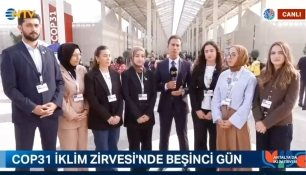
The topics of water security and marine pollution were also addressed in the conference’s media programs. Vice Rector Prof. Dr. Güleda Engin answered questions from Alihan Tok during Habertürk’s COP31 special broadcast, explaining the effects of microplastic pollution on marine ecosystems and the importance of advanced treatment technologies in protecting water resources.

Sharing findings from research conducted with support from TÜBİTAK, Engin noted that in some areas of the seas surrounding Istanbul, the number of microplastics per square kilometer exceeds 4 million. He pointed out that while the majority of microplastics are captured at wastewater treatment plants, the amount reaching the seas can still reach significant levels.
“Research conducted at universities should not remain merely at the level of academic papers,” Engin said, stressing that scientific research must be translated into practical applications at wastewater treatment plants. He assessed the potential contributions that advanced oxidation methods and membrane technologies could make in this process.

Prof. Dr. Afşın Yusuf Çetinkaya, a faculty member in the Department of Environmental Engineering, also shared his insights on water security, the effects of climate change on water resources, and the role of the oceans in climate balance during Habertürk’s COP31 special broadcast. Highlighting the importance of access to water and sanitation services for public health, Çetinkaya noted that pressure on water resources could increase climate-induced migration. Noting that the oceans play a crucial role in maintaining climate balance through their functions of carbon sequestration and heat absorption, he stressed the need to protect marine ecosystems.

The Future of the Circular Economy and Green Industrialization Were Discussed
The future of the circular economy was discussed at the “Beyond Recycling” panel organized as part of COP31. In the session moderated by Vice Rector Prof. Dr. Güleda Engin, the focus was on the efficient use of resources, the revaluation of waste, and the widespread adoption of a circular economy approach in production processes.
At the “Climate-Positive Biotechnology Specialized Organized Industrial Zones: Turkey’s Green Industrialization Model,” the future of biotechnology-focused industrialization and sustainable production was evaluated. Moderated by Prof. Dr. Afşın Yusuf Çetinkaya, a faculty member of the Department of Environmental Engineering, the panel featured Prof. Dr. Özer Çınar, Senior Advisor to the Rector and Deputy Chairman of the Board of Directors of YTÜ Yıldız Technopark, Prof. Dr. Cengiz Kaya, Deputy General Manager of YTÜ Yıldız Technopark; Dr. Ercan Varlıbaş, Chairman of the Board of Directors of the Biotechnology Specialized Organized Industrial Zone and the Biotechnology Industrialists Association; and Çağlar Kahraman, a member of the BİOSB Board of Directors, served as speakers.
The panel discussed the role of advanced wastewater treatment and water reuse, industrial symbiosis, resource recovery, renewable energy, artificial intelligence, and digital twin technologies in the industry’s green transition. The contributions that the university’s expertise in environmental engineering, sustainability, advanced technologies, and technology transfer could make to Turkey’s vision for green industrialization were discussed.

The role of women in the green industrial transformation was brought to the forefront
The opening remarks for the panel titled “Women Empowering Turkey’s Green Industrial Transformation,” organized by the university and held on November 14 at the Turkey Women’s Pavilion in the Blue Zone, were delivered by Fatma Varank, Deputy Minister of Environment, Urbanization, and Climate Change and CEO of COP31.
Prof. Dr. Gamze Varank, Dean of Students and a panelist, assessed the barriers to women’s representation in higher education and industry, as well as their participation in and leadership of the green transition. Addressing the support universities can provide and the necessary collaborations across the spectrum from technical education to employment, and from entrepreneurship to management, Varank shared examples of projects at YTÜ aimed at increasing women’s representation in industry.

The role of consumers in the clean energy transition was evaluated
The role of energy consumers in the transition process was discussed during the panel titled “Empowering Energy Consumers to Lead the Clean Energy Transition,” held on November 14 at the Blue Zone. Speaking at the panel, Dean of Students Prof. Dr. Gamze Varank explained the role of energy management in the GreenStars certification process.
Assessing the contributions GreenStars can make in helping organizations monitor their energy consumption, increase efficiency, and identify improvement steps, Varank shared the system’s potential to integrate conscious energy consumption into organizations’ daily practices and management processes by addressing green, social, and digital transformation collectively.

YTÜ Certification Hub and GreenStars Were Introduced
At the “Science, Innovation, and Green Transformation for a Sustainable Future” panel held during COP31, YTÜ’s and YTÜ Yıldız Technopark’s sustainability initiatives, the YTÜ Certification Hub, and the domestic certification system GreenStars were introduced.
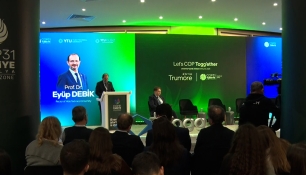
In his opening remarks, Rector Prof. Dr. Eyüp Debik highlighted the historical responsibilities of developed countries in the fight against climate change. Stressing that these countries must assume greater responsibility, provide funding, and share technology in proportion to their past carbon emissions, Debik noted that the goal of protecting the environment must not become a tool of pressure that curtails the right of developing countries to development.
Pointing out that Turkey must develop its own technologies and standards, Debik said, “We want Turkey to have a say as a country that develops the technologies of the green transition and contributes to the formation of international standards.”

During the panel moderated by Prof. Dr. Mehmet Burçin Pişkin, Vice Rector Prof. Dr. Güleda Engin discussed sustainable campus initiatives, while the Rector’s Chief Advisor, Prof. Dr. Özer Çınar, presented Yıldız Technopark’s green transition projects, while Dean of Students Prof. Dr. Gamze Varank shared the implementation and certification processes of GreenStars.
The launch of the YTÜ Certification Hub, which aims to integrate the university’s academic expertise into standard development, audit, and certification processes, is scheduled for November 27. Through GreenStars, the goal is to evaluate, audit, and certify institutions’ green, social, and digital transformation efforts based on measurable indicators.

From a student club to clean technology startups
Technology startups born from the 22-year legacy of the YTÜ Alternative Energy Systems Club (AESK) were discussed during a panel titled “From YTÜ AESK to Clean Technology Startups.” Associate Rector Prof. Dr. Güleda Engin also participated in the panel, which was moderated by Assoc. Prof. Dr. Ahmet Yiğit Arabul.
AESK President Alp Kaan Erkalkan, along with Mehmet Baylan from GESK Technology, Özkan Köroğlu from ROBEFF, and İrfan Güven Çömezoğlu from YED Technology, described the process by which projects developed during their student years evolved into startups. The panel discussed the challenges encountered, entrepreneurial experiences, and the role of university-industry collaboration in the clean technology sector. The transformation of initiatives that began in student clubs into technology startups highlighted the potential of young people to develop solutions to combat climate change.

International Pavilions and High-Level Visits
As part of COP31, the YTÜ delegation visited the pavilions of Turkey, Azerbaijan, and Kazakhstan to examine different countries’ sustainability and green transition initiatives.
During the visit to the Kazakhstan Pavilion, information was gathered on a project where plastic waste is recycled and used in the production of high-value-added fibers and fabrics. At the Turkey Pavilion, initiatives in the areas of zero waste, the circular economy, clean energy, and climate-resilient cities were examined. At the Azerbaijan Pavilion, information was gathered on renewable energy projects, green energy corridors, and initiatives aimed at protecting the Caspian Sea’s ecosystem. During the visits, discussions were also held with rectors, academics, and alumni from various universities.
Throughout the conference, high-level guests were also hosted at the YTÜ Yıldız Technopark booth. Minister of Labor and Social Security Vedat Işıkhan, COP31 President and Minister of Environment, Urbanization, and Climate Change Murat Kurum, and Istanbul Governor Davut Gül visited the booth to learn about the university’s and the Technopark’s sustainability initiatives. During the visits, projects in the fields of clean energy, resource efficiency, and environmental technologies, as well as innovative solutions developed by companies, were showcased.
YTÜ Brought Together Academia, Industry, and International Stakeholders at COP31
Throughout COP31, YTÜ shared its efforts to combat climate change with various stakeholders through panels, research and technology presentations, student projects, and international engagements. The program—spanning from clean energy to water security, and from the circular economy to green industrialization—highlighted the university’s approach to aligning scientific research with social and economic needs.
With the research of its faculty, projects developed by students, and technologies from companies at YTÜ Yıldız Technopark, the university emphasized the importance of science, innovation, and collaboration for a sustainable future at COP31.


Other News